Mobility Scooters – Buying Tips
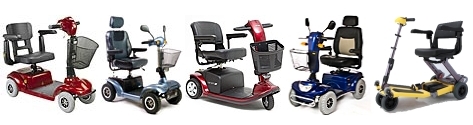
Thanks to tremendous advances in the design of mobility scooters over recent years, people who are physically challenged now can enjoy greater freedom and independence than ever before. Mobility scooters offer more maneuverability over motorized wheelchairs and provide the capability to make tight turns, navigate small spaces, and move over smooth and rough surfaces with ease.
As a result, people with limited mobility can enjoy a richer quality of life by more easily accomplishing daily tasks such as grocery shopping, going out to dinner, navigating shopping malls, and spending more time outside.
Selecting the right mobility scooter entails doing some research to make sure you get the features, functionality and comfort that address your needs. There are many decisions to make including size, weight, number of wheels, drive train, power system, battery life, seat style, steering, color, lighting, and storage capacity.
Decision Factors
Wheels: Three-wheeled scooter models are lighter and the most maneuverable; while four-wheeled scooters are heavier and more stable. A test drive will help you determine which you prefer for your lifestyle.
Tires: Choose the type and size of wheels based on how you plan to use your scooter. Tire sizes range from six to 12 inches. Smaller tires are best for indoor use that requires sharp turns and navigating tight spaces. Larger, wider tires are better suited for rough terrain and stability needs.
Drive Train: Your mobility scooter also comes with a choice of front or rear wheel drive. Front wheel drive models are lighter and designed for indoor use or traveling on level surfaces. They are smaller in size are more likely to be compatible with transport wheelchair lifts.
Front-wheel drive scooters do not have as much speed and duration as rear-wheel drive scooters that can traverse rougher terrain and handle more weight.
With rear-wheel drive models, you can achieve speeds of five miles per hour or faster with a range of approximately 25 miles before needing to recharge your battery.
Seating: Choose a chair for your scooter based on your individual comfort and utilization requirements. Most manufacturers allow you to select seat covering, swivel options up to 360 degrees, extra padding, lumbar supports, and powered height adjustments. Armrests are another consideration and can be added, removed or changed to address your needs.
Steering: Most scooters have handle-bar style steering with thumb controls or levers that allow the user to manage speed and drive the scooter forward or in reverse. Other steering systems that feature joy sticks and loop handles can be adapted according to manufacturer specifications.
Batteries: Batteries and chargers are usually considered add-ons and are not included in the base scooter price. Scooter power is most often generated from one or two 12-volt deep cycle batteries, depending on the model.
Depending on use, batteries typically last up to 18 months before they need to be replaced. Gel cell batteries are recommended for safety over other batteries types.
Other Features: There are a wide variety of add-ons and accessories you can purchase to equip your scooter to match your lifestyle. These include portable battery chargers, baskets, headlights and taillights, oxygen carriers, walker and cane holders, storage compartments, horns, and canopies.
Other Important Considerations
Before making a scooter purchase, it is important to test drive a number of models to determine comfort, ease of steering and functionality.
Ask about the specifics of your warranty and how you can get servicing or repair for your scooter. Ask about defect rate history and recalls, as well.
In addition, make sure you are provided with the total cost (including add-ons) in writing before making a final purchase decision.
Related Information - Mobility Scooters
More on Electric Scooters
Major Scooter Manufacturers
Tips on Scooter Selection
Cheap Electric Scooters - Where to Find Deals
Used Scooter Considerations
More on Buying a Pre-Owned Scooter


Popular ArticlesTypes of Mobility Chairs Wheelchair Sports Activities Helpful Resource Organizations Mobility Scooter Buying Tips Portable Ramp Options |