Selecting a Mobility Scooter
As you begin your search for a new mobility scooter, there are many factors and features to consider, including how and where you will use your equipment and your specific transport requirements. The following information summarizes some of the basics to consider in your search.
Number of Wheels
A mobility scooter can be equipped with three or four wheels and both options have their specific benefits.
A three wheeled model is typically more maneuverable and enables you to easily navigate in and out of tight spaces. It is usually lighter and best suited for indoor use.
A four-wheeled scooter is more stable but does not have as tight of a turning radius as three-wheeled models. It easily accommodates outside terrain and better handles curbs, bumps, and hills.
Drive Trains
Scooters come in both front-wheel and rear-wheel drive models. Front-wheel drive models are usually found on smaller scooters designed for indoor use.
They cannot carry as much weight as rear-wheel drive models and are not built to handle rough surfaces or elevation
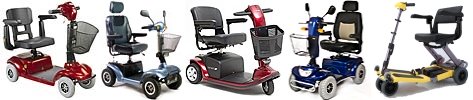
In addition, a front-wheel drive scooter typically has a smaller motor, which translates into less power, speed and range. Yet, these models are more adept at maneuvering in small spaces, around corners, and are lighter for transport.
Rear-wheel drive scooters are designed to push weight rather than pull it as in front-wheel drive models.
With the weight of the rider concentrated over the rear wheels, these models have greater capability to climb inclines -- and create better traction on rough surfaces.
In addition, these models typically have more speed capability and a longer range. The downside is that they are less maneuverable and some models may not be suited for indoor use. Some scooters have the ability to freewheel the drive wheels, allowing them to be pushed manually (though scooters overall are heavy and difficult to push without power).
Wheels and Tires
Like any other wheeled vehicle or equipment, the size of the wheels and tires on a scooter correlate to steadiness and travel capability on various surfaces.
Larger wheels and tires create more stability and allow for greater functionality riding over a wide variety of surfaces, including outdoor terrain, wet pavement, curbs and hills.
Smaller wheels and tires make it easier to navigate cramped spaces and tight turns. As a result, smaller wheels are best suited for indoor use or on smooth, flat pavement.
Scooter tires can be upgraded to enhance shock absorption and reduce maintenance. Your tire options include everything from standard rubber tires to those with air-filled tubes, anti-flat compounds, foam inserts, different types of tread, and tires that are specially treated to prevent scuff marks on floors.
Seating
Choosing the right scooter seat can make the difference to your comfort and scooter functionality. Seats are usually padded to provide shock absorption and can be adjusted to maximize your visibility, seat height, comfort and circulation.
You should be easily able to reach all controls from your seated position and feel no pressure from sitting when you ride. Some scooter manufacturers offer custom seats, lumbar supports and separate cushions to maximize comfort.
Armrests are another consideration and may not come with all scooters. Those that do may have armrests be fixed in place or designed to swivel or flip up to help with transfers on and off of the mobility scooter.
Steering Controls
When selecting a scooter, you need to be comfortable with how to steer and operate the controls on the model you are considering. Thumb levers are the most common mechanism and allow users to adjust speed and move the scooter forward and in reverse while keeping their hands safely on the handle bars. Some scooters have joysticks or other types of finger levers to control speed and direction.
Before Making a Mobility Scooter Purchase
- Always test drive a number of models for comfort and functionality.
- Make sure you are provided with the total cost of your scooter in writing, including add-ons, accessories, upgrades, battery (which is usually extra) any delivery or shipping charges, and tax.
- Inquire about warranties and how your scooter will get serviced.
For more information on selecting a mobility scooter click here.
Related Information - Mobility Scooter
Mobility Scooter Lifts
Mobility Van Sales
More Tips on Purchasing Scooters


Popular ArticlesTypes of Mobility Chairs Wheelchair Sports Activities Helpful Resource Organizations Mobility Scooter Buying Tips Portable Ramp Options |